Arts and Sustainability: Kacey Stonnell
Posted on 26 August 2026
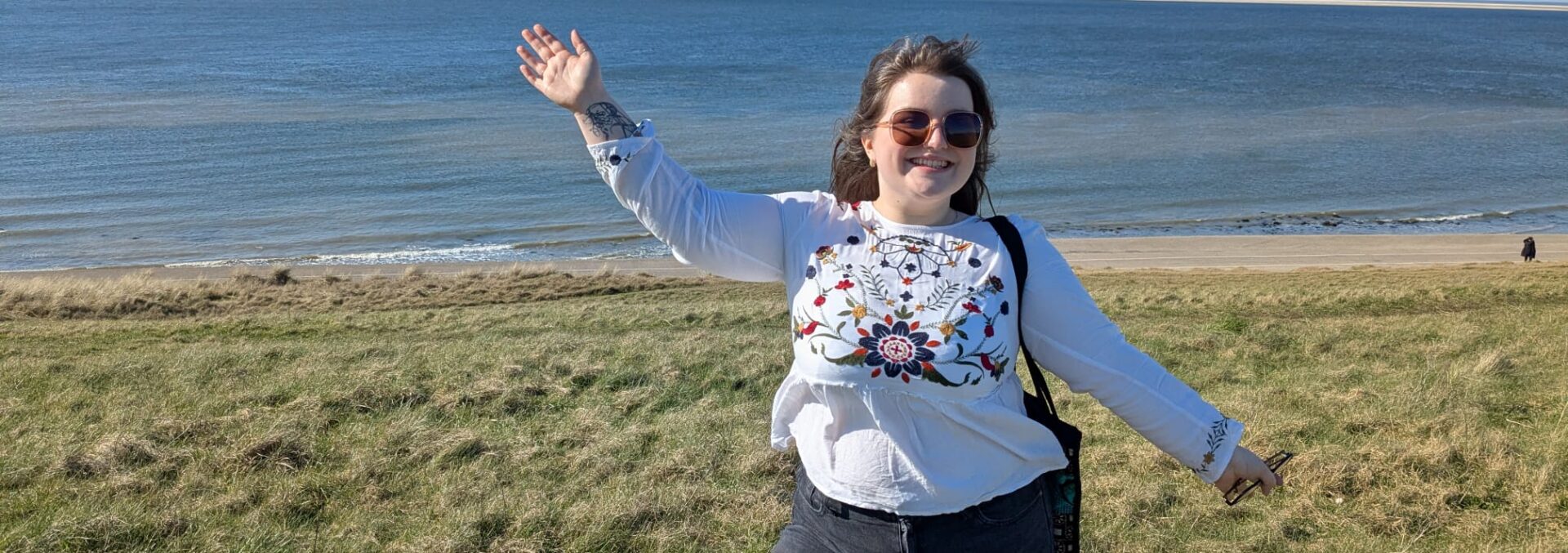
This month we caught up with Castlefield Gallery & Volunteer Coordinator Kacey Stonnell for our ongoing series Artists and Sustainability, where we ask artists or those who work in the cultural sector to share short responses about their work and how it might relate to climate change.
Does nature, the environment or looking after the planet influence your work in any way?
Yes. I grew up in a small village in East Lancashire, surrounded by fields, allotments and hills, and I genuinely felt like I had one of the most beautiful places in the world around me. Being surrounded by so much wildlife, and seeing how closely everyday life was connected to the land through things like allotments and growing food, helped me understand nature and human life as being tangled up with one another, rather than as two separate things.
I increasingly think of human and natural history as being one and the same. That is where a lot of my environmental thinking comes from. I take quite an anti-humanist position in my work when I can: I don’t believe humans should automatically be considered the centre of everything. At the same time, I recognise that we operate within systems that are fundamentally human-centred, so negotiating that tension is an ongoing part of how I think about environmental action.
At Castlefield Gallery, that thinking feeds directly into my work. I support our environmental action in a number of ways, from considering our day-to-day environmental impacts and how we can reduce them, to supporting our Artist Environmental Lead, Jane Lawson, and helping deliver Carbon Literacy training for the team. I have also been working closely with artist Lucy Wright on Wild Witness, our upcoming programme which follows on from Remember Nature 2025. The project invites people to engage with the world around them and to walk alongside our ‘more-than-human’ neighbours, so it connects very naturally with the way I think about the environment.
I think this perspective also makes me consider environmental action as something broader than simply reducing carbon. Carbon reduction is obviously important, but so are contribution, participation and empowerment. For me, environmental responsibility in the arts is about thinking about the systems we are part of and asking how we can make those systems better.
Do you make any choices in the way you work with artists that help the environment?
Yes. One of the most important things is having open conversations with artists about materials and how they are sourced, used and disposed of. We try to think about the environmental impact of those choices rather than treating materials as something separate from the work. That doesn’t necessarily mean telling an artist what they can or cannot use. It is more about creating space for conversations around why particular materials are being used, where they come from, whether they can be reused, and what happens to them afterwards. Sometimes those conversations lead to very practical changes; sometimes they simply make us more conscious of the decisions we are making.
Wild Witness has been a particularly good example of this. In developing the project with Lucy, we have talked not only about the environment as an abstract idea, but about Manchester itself: its changing landscape, the development of the city, the effects those changes have, and the different ways organisations and companies are now thinking about rewilding and environmental investment. Those things have knock-on effects, and they have influenced how we have approached the project, including the route itself. We are trying to hold some of those contradictions together, the built and the wild, development and conservation, the positive and negative impacts of change.
I think it is important that environmental responsibility doesn’t become another set of restrictions placed on artists. Artists need the freedom to experiment, but galleries also have a responsibility to ask questions about the resources and systems that make that experimentation possible.
Do you think artists and galleries can help people think differently about the environment?
Definitely. I think artists are particularly good at helping people encounter ideas that they might otherwise find difficult to engage with. Environmental issues can very quickly become a series of statistics, targets and frightening headlines. Art can create a different kind of relationship with those issues, one that is emotional, experiential, or even uncomfortable.
At Castlefield Gallery, we see artists as people who can lead conversations within the sector rather than simply responding to conversations that are already happening. Environmental thinking is a really strong example of that. Artists are exploring changing landscapes, climate, biodiversity, materials and our relationship with the more-than-human world in ways that can challenge how audiences understand those subjects.
I also think galleries have a responsibility to listen. We need to listen to artists, but also to our audiences and communities, and recognise that those conversations can inform one another. A gallery can provide a space where different perspectives meet, and where environmental questions can be explored without there necessarily being one simple answer.
Importantly, environmental action in the arts doesn’t have to mean that every exhibition or event has ‘the environment’ as its central theme. I think it is more useful to see it as an ongoing practice of reflection and action. It can be present in the subject of an exhibition, but it can also be present in how we build an exhibition, what we buy, how we travel, what materials we use and what we do with them afterwards.
I think artists are particularly good at helping people encounter ideas that they might otherwise find difficult to engage with. Environmental issues can very quickly become a series of statistics, targets and frightening headlines. Art can create a different kind of relationship with those issues, one that is emotional, experiential, or even uncomfortable.Kacey Stonnell
Have you learnt anything about putting on exhibitions and events in a more environmentally friendly way that you’d like to share with other artists or visitors?
Probably the biggest thing I’ve learnt is that environmental responsibility doesn’t have to be one huge decision. It is often a collection of much smaller decisions that you make repeatedly.
At Castlefield Gallery, we try to consider our environmental impact throughout the process of putting on an exhibition or event. That can mean thinking about the materials we use to build walls, where we source paper and other supplies, what we purchase, how things are transported, what can be reused, and what happens to things once an exhibition comes down. None of these decisions exists in isolation: they affect our artists, our partners and our audiences.
I think the important thing is to build environmental thinking into your normal way of working rather than treating it as an additional task. You don’t have to wait until you are putting on an explicitly environmental exhibition to think about your impact.
I’d also say that it is important to be honest about the fact that you won’t always get it right. Environmental action in the arts is an ongoing process of reflection, action and repetition. We look at what we are doing, identify where we can improve, make changes, and then keep looking again.
For me, the most useful question isn’t necessarily ‘How can I make this completely sustainable?’, because that can feel impossible. It is ‘What impact is this decision having, and is there a better way of doing it?. If artists, galleries and audiences keep asking that question, those individual choices can start to add up to meaningful change.
To find out more about Wild Witness and book onto the event, click here.